
Claiborne 72-Hour Release Route
The official Claiborne County Sheriff page identifies Sheriff Edward Goods and offers the sheriff’s duties and contact information, but it does not publish a rolling 72-hour release view. No release filter, archive, public roster, photo gallery, refresh cadence, retention window, or mobile jail app was verified. The practical route is to ask whether the office holds an existing booking or release report for a clearly stated three-day period. If it does not, request the release or discharge line for each identified booking.
The sheriff at 601-437-5161 is the custodian for the county jail docket. That record can show whether county custody ended by bond, court authority, time served, transfer, or another recorded manner. A transfer to MDOC or another custodian should not be listed as a community release merely because the person left the Claiborne County Detention Center.
Check Claiborne 72-Hour Releases
A three-day request needs exact boundaries. State the start date, start time, end date, end time, and that the times are local. Ask whether a returned timestamp is the physical release-processing time or the later database-entry time. This distinction helps when a weekend event is not entered or visible until staff complete the record.
- Set an exact 72-hour period in local time rather than using only “the last three days.”
- Ask the sheriff whether an existing booking or release report covers that defined span.
- If no range report exists, supply a full name, date of birth, approximate booking date, and booking or case number for each person.
- Request the jail-docket release manner, authority, date and time if recorded, and any receiving agency or penitentiary receipt.
- Check the court, MDOC, MS SAVIN, BOP, or ICE record that matches the stated destination.
The Public Records Act addresses access to existing records. It may not require an agency to program a fresh date-range export. A narrow request for an existing docket entry avoids that problem and creates a better identity match.
Note: Define all three days precisely because “today” and “weekend” do not identify a fixed records interval.
Claiborne 72-Hour Record Fields
Because there is no county web feed, the table describes fields to seek from the jail docket or an existing release report, not columns promised on a public screen. Mississippi’s jail-docket statute provides the strongest local field set. Ask for the release wording exactly as recorded and avoid turning a transfer into a release to the community.
| Requested field | Why it matters in a three-day check |
|---|---|
| Full name and booking number | Separates people with similar names and ties the outcome to one custody episode. |
| Reception or commitment date | Shows when the county custody period began, even if it began before the 72-hour window. |
| Release or discharge date and time | Places the event inside or outside the requested local-time boundaries when recorded. |
| Release manner | Distinguishes bond, court release, time served, transfer, or another documented outcome. |
| Release authority | Links the exit to the warrant, order, or other source that authorized it. |
| Receiving agency or receipt | Shows when county custody ended but confinement continued with another custodian. |
A photograph should be requested separately because no county source says a public release record includes one. Photo creation proves a booking image existed. It does not establish release, conviction, disposition, or the date county custody ended.
Claiborne Weekend Release Timing
The wider window is useful around a weekend or holiday because a one-day check can cut across processing and entry times. Still, no Claiborne source documents a special weekend-release policy or a guaranteed posting schedule. Do not assume that a Monday observation means a person physically left on Monday. Ask the custodian what each timestamp represents.
A court order can authorize release before staff complete physical processing. A source-system event can be entered after the person moves. MS SAVIN can then alert after the participating agency sends an update. Each is a distinct time. Retain the source and observation time for every result instead of selecting the latest-looking date.
| Date or time | Meaning |
|---|---|
| Court-order time | When a judge or court record authorized an outcome, not necessarily physical exit. |
| Release-processing time | When the holding agency completed the recorded custody exit. |
| Database-entry time | When staff entered or transmitted the event to a system. |
| Observation time | When a researcher saw the current status, which may later change. |
Why Claiborne Lacks Release Archives
The distinctive local fact is the absence of a public county feed, not proof that the underlying records vanish after three days. The sheriff page contains no roster link, recent-release filter, archive, or online retention term. Commercial directories and search-engine caches cannot supply the county’s missing official cadence. Their dates may show when content was copied, indexed, or refreshed rather than when a person left custody.
The lasting local record is the jail docket required by Mississippi Code Section 19-25-63. It records duration and how release or discharge occurred, including the release warrant or a penitentiary officer’s receipt. Local government records may be destroyed only under an approved retention schedule. The exact series must be checked before anyone promises how many years a docket, photo, or related file remains available.
The sheriff screenshot below shows the official contact-and-duty route that replaces a public Claiborne County recent-release screen. The live sheriff page should be rechecked for later changes.
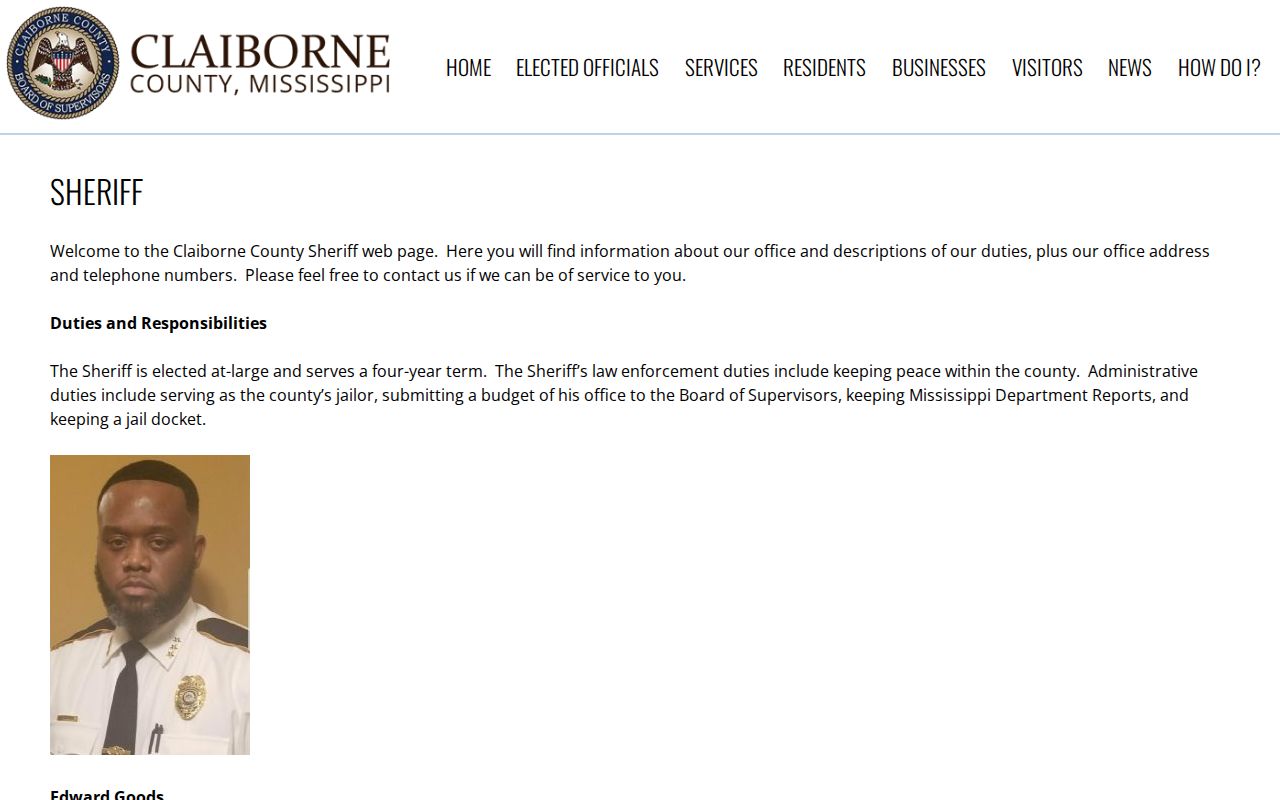
This source supports a records-navigation page. It does not support publishing a faux list of names or borrowing another Mississippi county’s feed.
Note: Online absence is not a three-day retention rule; verify government retention for the exact record series.
Claiborne Release Custody Paths
The right follow-up depends on the docket outcome. A person bonded out locally may never appear in MDOC. Check the county release entry and court bond order. If the docket shows a penitentiary receipt or MDOC transfer, use the state offender search by name or MDOC number. A current state facility means confinement continued. A community-corrections status means release from confinement under supervision, not full sentence discharge.
- Release
- The named custodian ended its custody under a recorded authority.
- Transfer
- One custodian ended control because another agency received the person.
- Discharge
- A record showing an agency’s custody or supervision relationship ended, subject to the exact source wording.
- Detainer
- A request or basis for another authority to take custody after the first agency’s hold ends.
For federal custody, use the BOP locator and federal court docket. For possible immigration custody, use ICE ODLS. MS SAVIN/VINELink can provide a release or transfer notification from a participating county or state record, but its event should be confirmed with the agency that reported it.
Claiborne Released Versus Current Custody
A current roster, if one later becomes available, would answer who is displayed in custody at that moment. It would not reconstruct who left during a prior three-day span. Claiborne County currently publishes neither that roster nor a recent-release archive. The jail docket and court record remain the durable routes for a past county event.
A missing name is weak evidence. Spelling, aliases, delayed entry, transfer, sealing, source scope, and the absence of an online system can all produce a miss. Use a date of birth, booking number, court case number, MDOC number, BOP register number, or A-number when available. Names alone are not reliable identifiers.
For a same-day interval, use Released Last 24 Hours. For one named person whose path may extend beyond the three-day period, the Claiborne County release search and records route connects the sheriff, courts, and later custodians.
Verify Claiborne Three-Day Releases
Close the check by building a short chain of evidence. Start with the sheriff docket entry, add the court order or disposition that explains the authority, and add the receiving-agency or supervision record when the person did not return directly to the community. Keep source dates and meanings attached to each fact.
If two official records differ, note the conflict and each system’s update time. Contact the office that created each record. Do not silently choose the result that seems newest. The goal is to identify how Claiborne County custody ended and where the person’s custody status went next, not to force every event into one “released” label.