
Federal Custody Release Routes
No BOP prison in Claiborne County was identified. Federal defendants may be held in contract beds elsewhere while the U.S. Marshals Service controls pretrial custody and transport. After a federal prison designation, the Bureau of Prisons becomes the main public locator. This is a custodian map, not one local facility.
A release order can return a defendant to the community under court conditions. Transfer from a county or contract bed during USMS movement is not release. A BOP record with a past date and “Released” or no current location establishes that BOP custody ended. It does not exclude supervised release, ICE detention, state custody, or another hold.
| Federal stage | Best source |
|---|---|
| Pretrial detention or release | Federal court docket |
| USMS transport | Court and responsible USMS context |
| Federal prison term | BOP inmate locator |
| Past BOP release | BOP result plus court judgment |
Search Federal Release Records
The BOP inmate locator covers federal records from 1982 forward and updates daily. Search by exact name with optional age, race, and sex, or use a BOP register, FBI, DCDC, or INS number. A number search is stronger than a name-only match.
- Choose the BOP number or name search.
- Enter the best durable identifier available.
- Compare register number, age, race, sex, release date, and location.
- Read a past date with Released or no facility as the end of BOP custody only.
- Check the federal docket for judgment, detention, release, and supervision orders.
The Claiborne County release search is the better start when federal custody is not established. Neither MDOC nor the county roster can prove a BOP release.
BOP Historical Release Meaning
BOP explains the difference between past and projected release dates. A future date may change through recalculation, including First Step Act changes. “UNKNOWN” may mean the confinement term is not yet determined. Older pre-1982 records may require the National Archives rather than the live locator.
The official BOP records explanation supplies the historical and status context.
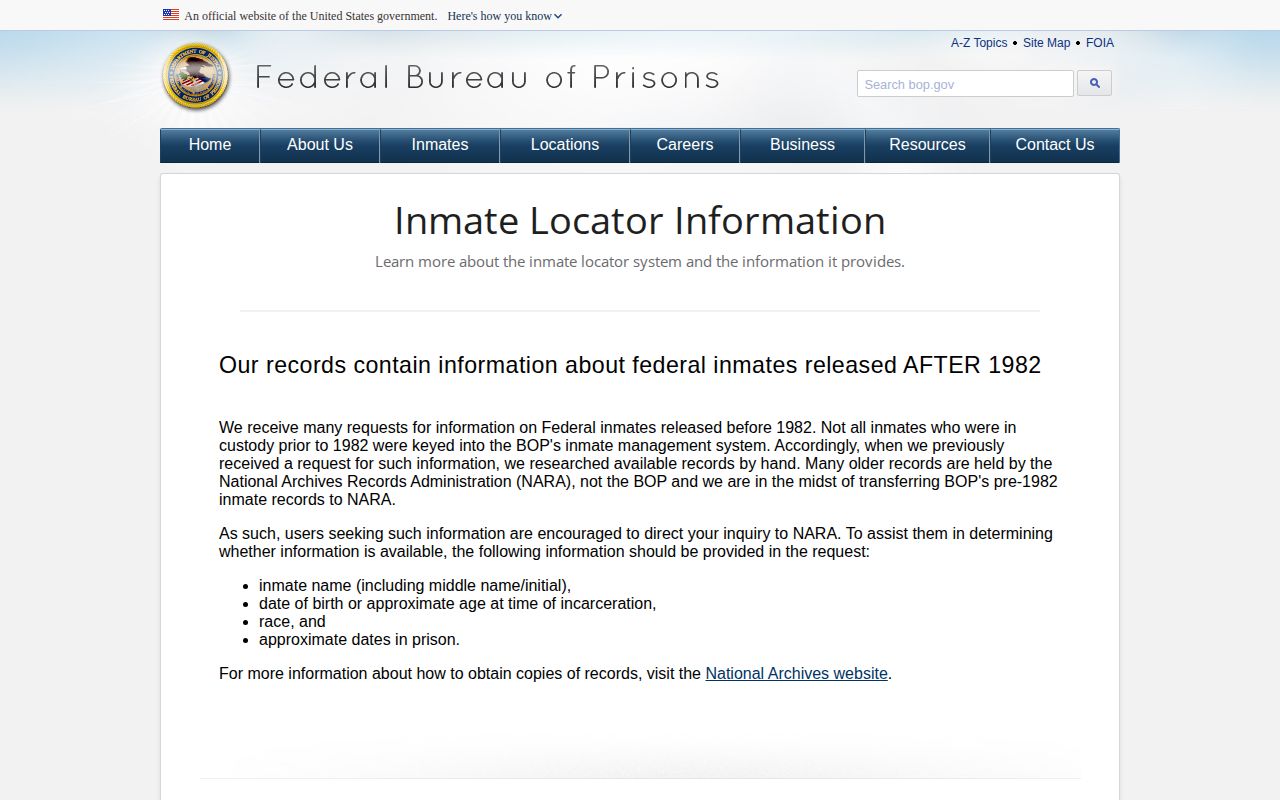
The capture helps distinguish a past BOP date from a current prison location and from post-prison supervision.
For more detail, use the BOP records or FOIA route with the person's full identifiers. Access to personal material may require identity proof or authorization. Ask for the exact record rather than a broad narrative.
Federal Court Release Orders
The Southern District of Mississippi federal court docket holds detention orders, release orders, dismissals, judgments, and conditions for federal cases in the area. A judge's order supplies legal authority. It may not show the precise hour when the holding facility completed release processing or a transfer.
USMS has no public historical released-inmate locator comparable to BOP. A person can leave a contract jail and remain in Marshal custody during transport. Check the docket and identify the custodian before describing movement as community release. PACER or CM/ECF access may require registration and current fees.
Federal supervised release is a court-ordered period after confinement. It is distinct from Mississippi parole and from MDOC supervision. A BOP Released result can coexist with active federal supervision. The judgment and later docket entries show its terms and any revocation action.
Note: The federal release order and BOP result answer different questions about legal authority and the end of prison custody.
Federal Custodian Contact Route
Because no local BOP prison was identified, there is no supported Claiborne County federal facility address or release desk to publish. Use the locator's facility result for a current BOP inmate, then follow the official facility contact shown there. Use the federal case docket for a pretrial defendant.
No physical Claiborne County BOP facility documented
BOP inmate locator
Southern District of Mississippi court
Use the live record to identify the responsible office
Do not invent a local address from a commercial detention listing. Contract placements can change, and a defendant may be moved across district or state lines. The official result and docket provide the current route.
Federal Release Custody Handoffs
A Claiborne County jail record can show a handoff to USMS or another federal authority. Mississippi's jail-docket law requires the sheriff to record how a person was released or discharged and the relevant release warrant or receipt. That county record proves the local handoff. Federal records then control the next stage.
If ICE takes custody after BOP or USMS, search the ICE locator with an A-number and country of birth when possible. If Mississippi takes custody, use MDOC. If another county takes custody, contact that county. Never treat the end of one sovereign's custody as proof that all custody ended.
- Sovereign
- A government authority with its own custody power.
- Designation
- BOP assignment to a federal prison or program.
- Supervised release
- Federal court supervision after confinement.
- Contract bed
- A non-BOP site used to hold a federal detainee.
Federal Release Record Bundle
A sound federal check starts with the case number and BOP register number. The court docket identifies the legal case, detention decision, judgment, and supervised-release terms. BOP identifies federal prison custody and the public release date. If the person was held under USMS authority in a contract bed, the docket and responsible district provide context that the public BOP search may not show.
Use the result's observation date. BOP updates daily, and projected dates can change. A screenshot is evidence of the interface at one moment, not a permanent certificate. If a past date matters, save the register number and request the appropriate federal record. Pre-1982 custody may require archival research.
When the county jail was part of the route, add the Claiborne sheriff's jail-docket entry. Its receiving receipt can establish that local custody ended through a federal handoff. Then follow federal sources. If the federal record later shows Released, check whether a state warrant, immigration detainer, or another sovereign took custody. The end of BOP confinement and return to the community are not always the same event.
Federal release also does not decide the underlying case by itself. A person may leave pretrial custody while prosecution continues, or finish prison while court supervision continues. Read the result with the filed order and judgment. This source-by-source method is slower than a name search, but it produces a record that explains the custody path instead of merely showing that one locator no longer has a facility.
Preserve the BOP register number, federal case number, release-status wording, and lookup date. Durable identifiers let the court, BOP, archives, and any receiving custodian address the same person and event.
Claiborne Federal Release Reconciliation
A Claiborne County record and a federal record can describe consecutive custody stages. If the sheriff's docket names USMS or another federal authority, request the receiving receipt and exact handoff date. Then use the Southern District case number and a federal identifier to continue the timeline. A local discharge line establishes only that the sheriff's control ended.
For a pretrial defendant, the federal docket is the main legal source. Read the detention or release order, later conditions, dismissal, and judgment. USMS transport between contract beds can cause a person to leave one facility without entering the community. Because USMS has no public historical release locator like BOP, a missing BOP record cannot by itself establish what happened during the pretrial stage.
For a sentenced person, use the BOP register number whenever possible. Compare the public result with the judgment and note whether the displayed date is future or past. A future date remains projected. A past date with Released or no location documents the end of BOP confinement, but court-ordered supervised release may continue. Another state, local, or immigration custodian may also receive the person.
Identity should be checked across both systems. County booking number, federal case number, BOP register number, date of birth, and sentence details are stronger than a name or image. If the dates conflict, record each field and its source rather than choosing one. Ask BOP about BOP data and the court about filed orders. Pre-1982 prison history may require the National Archives, while recent locator information is updated daily and should carry the date it was observed.