
Claiborne Projected and Actual Dates
The custodian supplies the date that matters. For a person sentenced into Mississippi state custody, the Mississippi Department of Corrections, or MDOC, calculates sentence-administration dates. Its public detail page uses the exact label Tentative Release Date. The word tentative is central: it describes a prospective calculation, not a certificate that release occurred.
A pretrial detainee at the Claiborne County Detention Center usually has no sentence-based release date. Bond, a court order, dismissal, a later judgment, or transfer can control the next custody event. A person serving a purely local sentence needs the court judgment, jail-credit information, and sheriff record. MDOC's date cannot be copied onto a county-only sentence it does not administer.
Actual release also needs a defined custodian. Leaving Claiborne County custody can mean community release, transfer to MDOC, another jail, federal custody, or ICE. A receiving-agency entry means custody continued even though the person left the county facility.
Find a Claiborne Release Date
Start with the last known custodian and a durable identifier. Use the full legal name, date of birth, booking or court case number, or MDOC number. Dates and photos can aid a match, but a name or appearance alone is not enough.
- For local custody, call the Claiborne County Sheriff at 601-437-5161. Ask how to obtain the jail-docket entry for the identified booking and whether a release or transfer has been recorded.
- Check the Claiborne County court case for bond, judgment, sentence length, jail credit, amended orders, or revocation. A court order can authorize release without proving the time jail processing ended.
- If the county record shows transfer to MDOC, search the MDOC inmate search by name or MDOC ID. Match the county, sentence, descriptors, and identifier.
- Open the MDOC detail and read location, sentence data, and Tentative Release Date together. A prison unit indicates present state confinement.
- After the expected date, seek the retrospective release or discharge record. If supervision follows confinement, confirm that status through MDOC Community Corrections.
The Claiborne County released inmates search covers the full county jail-docket and court path. A missing MDOC result cannot prove release because spelling, timing, identifiers, or system scope can cause a miss.
Note: Record each portal observation date because a live location or tentative release field can change after a new custody event.
Mississippi Release Date Computation
The sentence judgment is the starting record. It supplies the total term, sentence date, mandatory portions, enhancements, and whether terms run together or one after another. MDOC then applies verified county-jail credit where eligible and classifies the sentence under the laws in effect for the relevant offense and sentence dates.
Mississippi Code section 47-5-138 governs earned time, section 47-5-138.1 covers meritorious earned time, and section 47-5-139 contains exclusions and limits. Section 47-7-3 addresses parole eligibility. These laws have changed more than once. Offense type, date, habitual status, statutory exclusions, credits, and court terms can alter the path, so a simple sentence-length calculator is unsafe.
The common “85 percent” shorthand requires care. Historically, a limit of no more than a fifteen-percent administrative reduction applied to specified MDOC sentences, but later reforms and distinct parole or ERS routes can lead to different outcomes. It is false to state that every Mississippi prisoner serves the same fraction. MDOC's official computation controls the individual state sentence.
The MDOC supervision explanation describes ERS and the date framework used when a sentence begins.
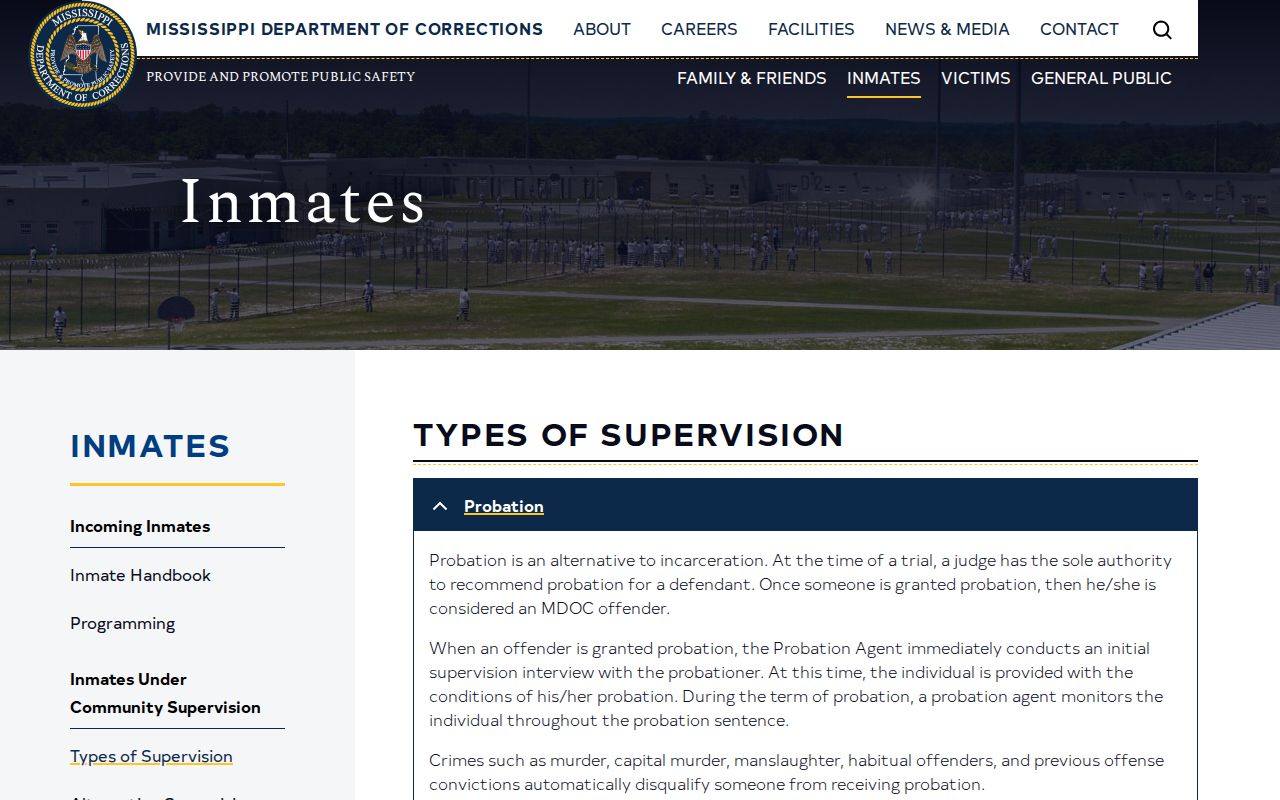
The captured state page helps distinguish a release to supervision from final discharge, which may occur later.
Why Claiborne Release Dates Move
A tentative date is recalculated when the underlying sentence facts or credits change. Some factors can move it sooner, others later, and some change only the type of custody at the end. A parole eligibility date is not a promise of parole, while a grant still may depend on a plan and MDOC processing.
| Factor | Possible effect | Record to verify |
|---|---|---|
| Verified jail credit | Eligible time may reduce time left | Judgment, jail-credit record, MDOC time sheet |
| Earned or meritorious credit | May move an eligible calculation earlier | MDOC calculation under current law |
| Discipline or credit loss | Can move the date later | MDOC sentence record |
| Amended court order | Can shorten, lengthen, or restructure the term | Filed amended judgment |
| New or consecutive sentence | Can add time or change sequence | Court judgment and MDOC time sheet |
| Parole action | Can create a supervised release path or later review | Board decision and MDOC status |
| Detainer or receiving agency | May end one custody while another begins | Release entry and receiving-agency record |
When two official sources differ, keep both dates and their labels. Note when each source was checked, then ask the office that created the field to explain the discrepancy. Do not silently select the date that looks newer.
Claiborne MDOC Release Date Fields
MDOC detail records expose more than a date. The context fields help determine whether the record belongs to the right person and whether the person is still in state confinement. Open the result rather than relying on a search-result name.
| MDOC field | How it helps |
|---|---|
| MDOC number | Provides a durable state identifier beyond name |
| Photo and descriptors | Support comparison but do not conclusively establish identity |
| Entry and location dates | Show when MDOC custody began and when location changed |
| Location or unit | Helps distinguish prison confinement from another status |
| Offense, county, and sentence | Connect the state result to the Claiborne judgment |
| Tentative Release Date | Shows the current prospective state calculation |
The official MDOC example detail demonstrates this interface and its exact date label. It is an interface example, not a Claiborne County case example.
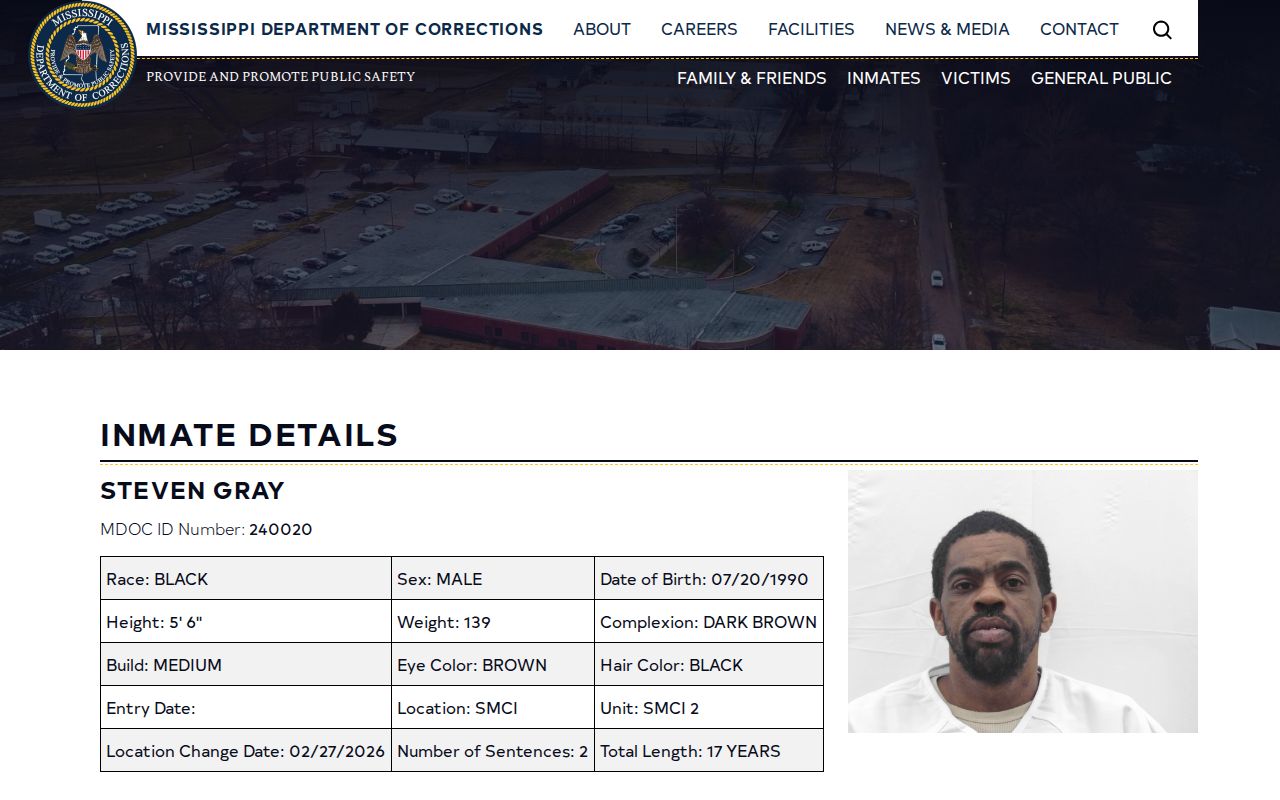
The screenshot shows why location, sentence, and tentative date must be read as one state-custody record.
Claiborne County Date Rules
No Claiborne-specific county-jail good-time rule or weekend-release policy was located in the official research. That absence matters. A short local sentence must not be estimated with MDOC's state-prison credits or the broad eighty-five-percent shorthand.
For a local sentence, collect the signed judgment, the court's jail-credit entry, any documented county rule that applies to that booking, and the sheriff's final jail-docket line. Mississippi Code section 19-25-63 requires the docket to show the duration of confinement and how the person was released or discharged. A penitentiary officer's receipt instead shows transfer into state custody.
A county release date and an MDOC tentative date can both be correct because they describe different custodians. The first may mark departure from Claiborne County custody. The second may forecast a later exit from state confinement. Keep both dates, their source, and the custody type in any notes.
Claiborne Court Release Date Records
The Claiborne County court file supplies facts that an inmate locator cannot. A judgment states the legal sentence, whether terms are concurrent or consecutive, and any jail credit recorded by the court. Later entries can include an amended sentence, revocation, dismissal, or order affecting custody. Search the correct court and case number because not every county booking becomes a Circuit Court felony case.
Claiborne County Circuit Court uses Mississippi Electronic Courts for its recent docket layer. The court is at 410 Market Street in Port Gibson, can be reached at 601-437-5841, and lists hours of 8 a.m. to 5 p.m. Its MEC go-live date was October 28, 2019. Older matters and cases from another court may need direct clerk retrieval rather than an online name search.
A release order and a physical release time are different. The judge can authorize bond, modify a sentence, or dismiss a matter, but jail staff must still process custody. The Claiborne sheriff's docket supplies the later entry showing how release or discharge occurred. Compare the order date with the jail event rather than substituting one for the other.
For a transfer to MDOC, obtain the Circuit Court judgment and the sheriff's penitentiary receipt, then match the MDOC number, conviction county, offense, and sentence. This chain shows when county custody ended, why state custody began, and which agency calculated the later Tentative Release Date.
Confirm Claiborne Actual Release
A future field must be checked again after the event. For a local booking, request the sheriff's jail-docket entry showing date, manner, authority, and any receiving-agency receipt. For state custody, read the updated MDOC status and request the releasable release or discharge record if the public detail remains unclear.
MS SAVIN through VINE can send a release, transfer, temporary-movement, escape, abscond, or return-to-custody alert when a participating agency updates its system. Register from the correctly matched person record, then confirm the alert with the named agency. The VINELink Release Check explains that one-person process.
Do not call a transfer an actual community release. A sheriff record may show MDOC, another county, federal authorities, or ICE as the receiver. Likewise, release from MDOC confinement to parole or ERS is not final discharge from the sentence. The later supervision record answers that question.
For old or missing records, use durable sources: the court file, sheriff docket, MDOC public-records route, and the responsible receiving agency. An empty current locator is not a historical record.
Federal and immigration dates belong to different systems. A Bureau of Prisons release date marks the end of BOP custody, while ICE's locator has its own current and recent scope. Neither date should replace a Claiborne County or MDOC calculation. If the county docket names a federal or immigration receiver, confirm that separate custody before describing community release.
Final discharge may occur after release from confinement. Parole, ERS, probation, and other supervision can keep a sentence relationship active in the community. Ask MDOC for the existing discharge record or inspect the court file for termination of probation when the question is sentence completion rather than prison departure.
If parole affects the expected state date, the Mississippi State Parole Board record supplies the decision and MDOC supplies the processed status. The Warren Probation & Parole Office can help confirm the assigned regional supervision office after release. Neither source should be used to overwrite the sheriff's physical county release entry.
Note: A date becomes proof of release only when the responsible custodian records the completed event and its custody outcome.